

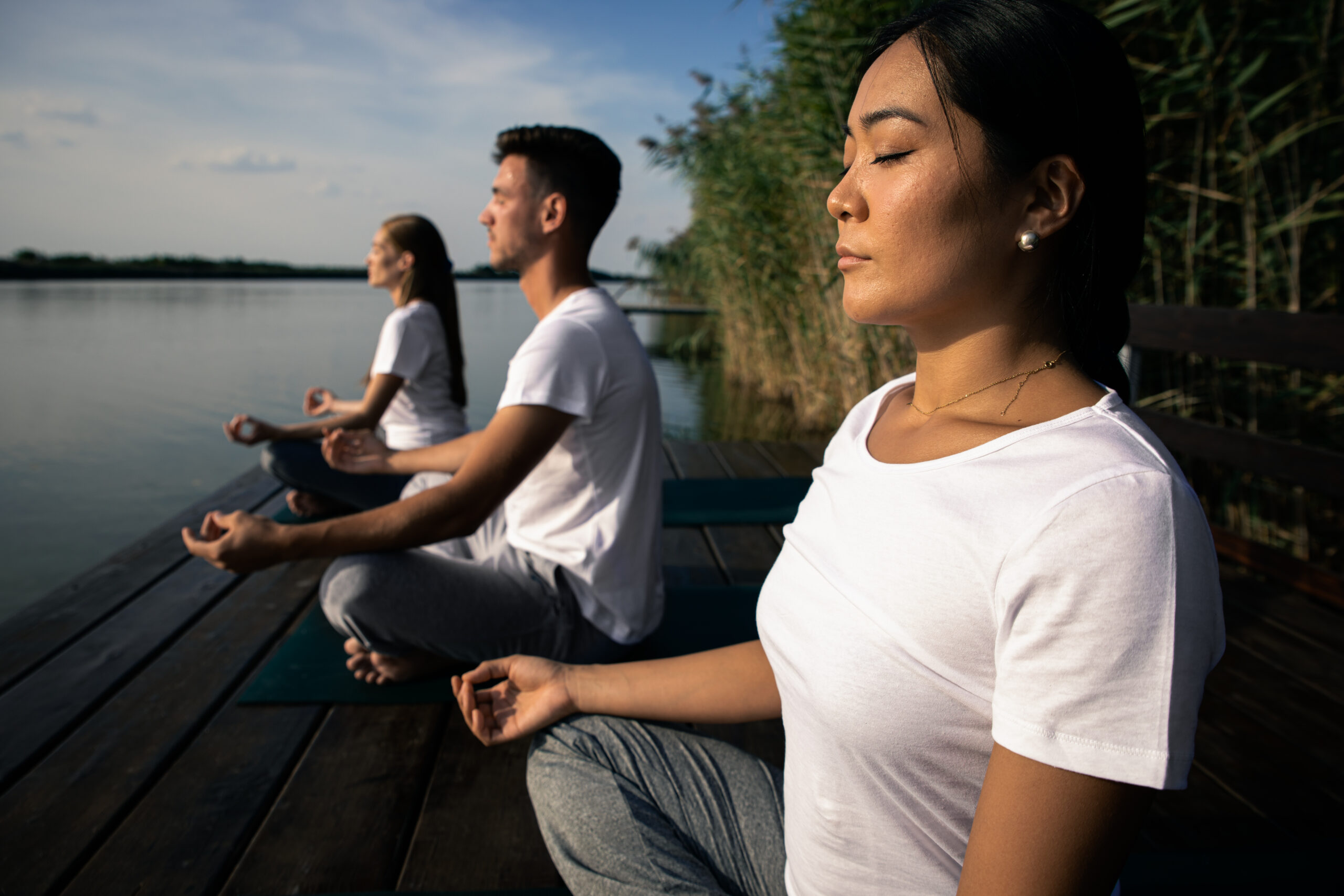
Breathwork is one of the simplest and most effective ways to regulate stress and improve focus. By shifting from shallow, unconscious breathing to slower, intentional patterns—like extended exhales or box breathing—you can directly influence your nervous system, calming your body and sharpening your attention. The key isn’t intensity or complex techniques, but consistency and awareness. Small, deliberate adjustments to your breathing throughout the day can reduce anxiety, improve clarity, and build long-term resilience.
There’s nothing simpler than breathing. It’s something we do every moment of every day, without even thinking about it.
If you were to pass out, you’d keep breathing.
But what if we occasionally paid attention to it, with intention? And what if there were incredible, scientifically proven benefits to our well-being in doing so?
Turns out that surprising statement is actually true.
Breathwork is often framed as something dramatic. In some social media content, it’s represented as an entry point into altered states, deep emotional release, or even transformation. And there’s some truth to that. But these aren’t the most valuable and accessible functions of breathwork in everyday life.
That’s because breathing is one of the few systems in the body that’s both automatic and under voluntary control. It’s happening constantly, quietly, without effort. And yet, for most people, it goes almost entirely unexamined.
The primary role of breath is regulation. It’s the body’s built-in mechanism that helps calm, energize, and stabilize us. When we understand breathwork through this lens, it becomes less about achieving something extraordinary and more about working skillfully with something that’s already happening all the time. And that’s worth trying, for all of the beneficial reasons that I’ll outline in this piece. Let’s take a closer look.
Starting With the Basics: How Are You Breathing?
How are you breathing right now?
There are two broad patterns most people fall into. Diaphragmatic, or “belly” breathing, is the gold standard. It involves the diaphragm expanding downward, allowing the abdomen to rise as the lungs fill with air. Chest breathing (AKA accessory muscle breathing), by contrast, is shallower, with more movement in the upper chest and shoulders.
Many people aren’t even aware of which pattern they default to. What happens to us is that over time, chronic stress tends to shift breathing toward a shallow, chest-based pattern. The body subtly shifts into a state of alertness and vigilance, and breathing becomes quicker, more restricted, and less efficient.
This shift often goes unnoticed because it develops very gradually. But over time, shallow breathing can reinforce feelings of tension, anxiety, and fatigue. So simply noticing where the breath is happening, paying attention to whether it’s in your chest or abdomen, can reintroduce choice into an otherwise automatic process.
Breathing as a Core Regulatory System
Breathing is often reduced to its most basic function: oxygen in, carbon dioxide out. But its role in the body extends far beyond the exchange of one molecule for another.
That’s because it turns out that breath is directly tied to the autonomic nervous system. That’s our bodily system that regulates our stress, relaxation, heart rate, and overall physiological state. Yep, it does some serious heavy lifting for us!
It matters because faster, shallower breathing tends to activate the “fight-or-flight” response that’s associated with the sympathetic nervous system. Slower, deeper breathing engages a different system, which supports calm, recovery, and restoration. This “downregulating” system that helps our bodies feel calm and relaxed is known as the parasympathetic nervous system.
This relationship works in both directions. Think about it this way: When you feel anxious, your breathing changes. But the reverse is also true. When you change your breathing, you can influence how you feel, as your mind starts to pay attention to the signals your body sends it.
This makes breathwork one of the fastest and most accessible tools for regulating both stress and attention. It doesn’t require special equipment, a particular environment, or extensive training. It’s always available, and its effects are often immediate when used intentionally.
The Overlooked Pattern: Holding Your Breath Under Stress
One of the most common things we do under tension is alter our breathing. Breathing patterns under stress start to resemble either rapid breathing, reduced breathing, or, in extreme cases, the absence of breathing altogether for long enough for the body to take over to restore breathing by temporarily “crashing” the system to allow for a reset, otherwise known as fainting.
We’ve all frequently held our breath during moments of emotional strain or tension. And the thing is, this isn’t just when we experience something dramatic like a car accident. This can also happen while reading a difficult email, anticipating a tough conversation with a partner or child, or navigating a tense work situation. The breath becomes shallow or pauses entirely without conscious awareness. Think of a moment of fear, and we hold our breath in anticipation. Except instead of a moment, it could last years.
This pattern is closely linked to the “freeze” response, a state in which the body becomes momentarily immobilized under stress. While subtle, holding your breath can intensify emotional experiences. That, in turn, can lead to heightened awareness and stress, which then feeds into the loop of increased tension, lower breathing, and increased bodily stress. It’s a cycle that keeps repeating. The natural regulation processes are being interrupted.
This sounds like a bad time (and it is!), but what’s encouraging is that interrupting that interruption is simple. Noticing the absence of normal breathing and taking one or two slow, deliberate, deep breaths can reset the system. That small shift can reduce the intensity and duration of the stress response, giving the rational brain and the body’s natural regulatory functions a chance to step in and do their jobs.
Common Misconceptions About Breathwork
Breathwork is often surrounded by misconceptions, particularly around the idea of “hyper-oxygenating” the body, which is a space with extreme beneficial claims and questionable scientific evidence to back them. In reality, high-quality reviews of scientific studies show that rapid or forceful breathing techniques don’t significantly increase oxygen levels. But they do perform a different function: reducing carbon dioxide in the blood.
This reduction in CO₂ can create sensations such as tingling, lightheadedness, or dizziness. These effects are sometimes interpreted as signs of increased oxygen or heightened energy, but they’re more accurately understood as fairly simple “cause and effect” physiological responses to altered gas balance, a mild respiratory alkalosis.
It’s worth being able to name and identify this aspect of the body’s response to deep breathing when in a heightened emotional state, because without this understanding, these sensations can feel alarming, especially for individuals prone to anxiety. Misinterpreting normal physiological responses can reinforce fear rather than promote regulation, which is clearly counterproductive.
A more grounded approach to breathwork focuses less on intensity and more on stability. That means a focus on slower, controlled breathing patterns that support the body’s natural regulatory systems.
This should also be the foundation built, in my opinion, before using breathwork for “transcendent” experiences.
Breathwork as a Tool for Stress Reduction
Have you ever experienced a stressful moment (a near miss while driving, an unexpected loud noise nearby) that passes quickly, but leaves you feeling tense and jittery for a long time after the actual event? You’re not alone.
Stress responses often outlast the situations that triggered them. The body can remain in a heightened state of alertness long after the external threat has passed, and it’s a natural, understandable response our bodies do to protect us from harm. Muscles lock up in preparation for the next shock. Breathwork offers a way to interrupt this lingering activation.
Certain techniques act as a kind of “reset button” for the nervous system. Box breathing—inhale, hold, exhale, hold in equal counts—creates rhythm and predictability. Similarly, the 4-7-8 method extends the exhale, promoting relaxation. The physiological sigh, a fast double inhale followed by a slow exhale, has also been shown to reduce stress quickly.
What these methods each share is a shift in the breathing pattern that signals safety to the body. By slowing the breath or extending the exhale, they help deactivate the stress response and restore a feeling of balance.
Breathwork for Improving Focus
We live in a culture where focus is often treated as a purely mental skill to be strengthened through willpower or discipline. But Eastern cultures in particular have long known that attention is deeply tied to physiological state. It’s for this reason that breathing is such a big part of Eastern practices that have been widely adopted, like yoga, meditation, and tai chi. We’ll get more into those in future posts.
When the nervous system is dysregulated, which means that it’s either overstimulated or fatigued, focus becomes difficult. People may experience this as a feeling of the mind being scattered, restless, or unable to hold attention. Breathwork can help by stabilizing the underlying state that supports concentration.
Using breath intentionally before or during cognitively demanding tasks can improve your clarity and endurance. A few minutes of slow, steady breathing can reduce background stress, making it easier to engage fully with the task at hand.
In this sense, focus is about creating the conditions necessary to support optimal thinking and problem-solving. Breathwork is a bit of a bypass, redirecting our physiology to be in the right state, rather than attempting brute force effort.
A Practical Approach: 1:2 Ratio Breathing
One of the simplest and most effective breathwork techniques involves extending the exhale relative to the inhale. A common example is a 1:2 ratio. In practice, that means simply doubling the exhale time when compared to the inhale time (i.e., breathing in for 4 seconds and out for 8, or 5 seconds in and 10 out).
The exact numbers matter less than the ratio. The key is that the exhale is longer than the inhale. This pattern activates the parasympathetic nervous system, promoting calm and reducing bodily arousal. But during the exercise (for a minute or 5 minutes or longer), keep the numbers the same once you start.
Another thing to keep in mind is that consistency is more important than precision. The breath should feel steady, not forced. Practiced regularly, even for a few minutes at a time, this approach can become a reliable tool for downregulating stress and stabilizing attention.
There’s no ideal way to breathe in every moment. What matters is returning to awareness and making small adjustments over time. A few intentional breaths throughout the day can be more impactful than occasional, longer sessions.
And like any skill, the effects accumulate over time. Regular practice strengthens the body’s ability to shift states more easily. Over time, this creates a more stable baseline of calm and responsiveness that you can access when you need to.
The Relaxation Response and Long-Term Benefits
Breathwork can activate what is often called the relaxation response. This is a physiological state characterized by reduced heart rate, lower blood pressure, and a general sense of calm, and a different aspect of the parasympathetic nervous system. Research on this is pretty deep and goes back to the 1960s, with Dr. Herbert Benson at Harvard.
This response counteracts the chronic activation of the stress system. Over time, regularly accessing this state can improve overall resilience, making it easier to recover from stressors and maintain emotional balance as we allow the “intentional” parts of our mind and body to take over from the more “reactive and emotional” responses that we generate.
The effects are similar to those seen in meditation, mindfulness practices, and even certain forms of hypnosis. What distinguishes breathwork is its immediacy. It can be engaged quickly, without preparation, and integrated into almost any context, whether that’s your work or personal life.
It doesn’t require setting aside special time or creating a specific environment. It can be integrated into daily routines, whether that’s while commuting, between meetings, before bed, or during moments of stress.
Breath becomes less of a tool you “use” and more of something you notice and gently adjust. This reframing makes breathwork more sustainable. It moves from something occasional to something embedded in everyday life.
Key Takeaways: From Automatic to Intentional Breathing
Breathing is something we do without thinking. But it’s also a tool we can use deliberately.
Small shifts in how we breathe can have a meaningful impact on how we feel, think, and respond to the world around us. Over time, these small adjustments accumulate, shaping a more regulated and resilient internal state.
As far as improvements to our well-being go, improving our awareness of our breath and doing it more intentionally when we need to is hard to beat for its simplicity and proven benefits.